More than Survival: Paris FC's defining first season back in Ligue 1
There was a moment, deep into stoppage time against Paris Saint-Germain, when everything seemed to crystallise for Paris FC.
Luca Koleosho burst forward down the flank, accelerating into open space with one final surge of energy in the closing seconds of the season. His run split the PSG defence before the ball arrived at the feet of Alimami Gory, who calmly finished to send Jean-Bouin into delirium.
A 2-1 victory over the French champions. A last-minute winner. The perfect conclusion to Paris FC’s first Ligue 1 campaign in nearly half a century.
But the eruption at full-time was about far more than one result. It capped off a season where PFC survived, despite the uncertainty, tension, and the adaption to a league which they hadn't participated in for decades.
A Return Years in the Making
For decades, Paris FC existed in the shadow of almost everyone. Overshadowed by their glamorous neighbours at PSG, drifting between divisions, and struggling to establish a stable long-term identity, the club often felt disconnected from the idea of top-flight permanence.
Promotion to Ligue 1 changed the mood instantly, but not necessarily the expectations.
Internally, the ambition was clear: build sustainably, avoid panic, and establish foundations for the future. The backing of the Arnault family and Red Bull’s growing involvement offered financial strength and long-term vision, but Ligue 1 remains unforgiving to promoted sides regardless of ownership structures.
The opening months reflected exactly that. There were flashes of promise mixed with periods of instability. Paris FC could compete physically and technically on certain nights, yet they struggled to maintain consistency over longer stretches.
Results became increasingly erratic during the winter. Performances lacked rhythm. Confidence slowly dipped.
The Crisis Point
The turning point came in February. A humiliating 5-0 defeat at home to RC Lens exposed the fragility of the team. More concerning than the scoreline itself was the feeling that the collective spirit had disappeared.
Internally, doubts emerged over the atmosphere around the squad and the direction of the season. According to reporting from L’Équipe, club leadership felt there had been “a rupture” between the team and its supporters as performances deteriorated. Just days later, the difficult decision was made to replace Stéphane Gilli.
At the time of his dismissal on 22 February, Paris FC still sat five points above the relegation play-off place. The timing surprised many observers, particularly given Gilli’s role in guiding the club to promotion. But the hierarchy believed something fundamental needed to change.
Antoine Arnault, heavily involved in the project and increasingly influential within the club, spearheaded the decision to appoint Antoine Kombouaré. The experienced coach had already been approached by FC Nantes for a potential return, yet chose the Paris FC project instead. It would prove transformative.
Kombouaré Changes Everything
The veteran coach arrived at the club with an immediate sense of authority. He did not attempt to completely reinvent the squad overnight. Instead, he simplified roles, restored confidence, and rebuilt emotional intensity inside the dressing room. His impact was almost immediate.
Paris FC suddenly looked more aggressive without the ball, more compact defensively, and freer mentally. Players who had appeared paralysed by pressure began expressing themselves again. Most importantly, the group rediscovered belief.
Kombouaré’s opening seven matches produced four victories and three draws — an unbeaten sequence that secured survival with weeks remaining in the campaign.
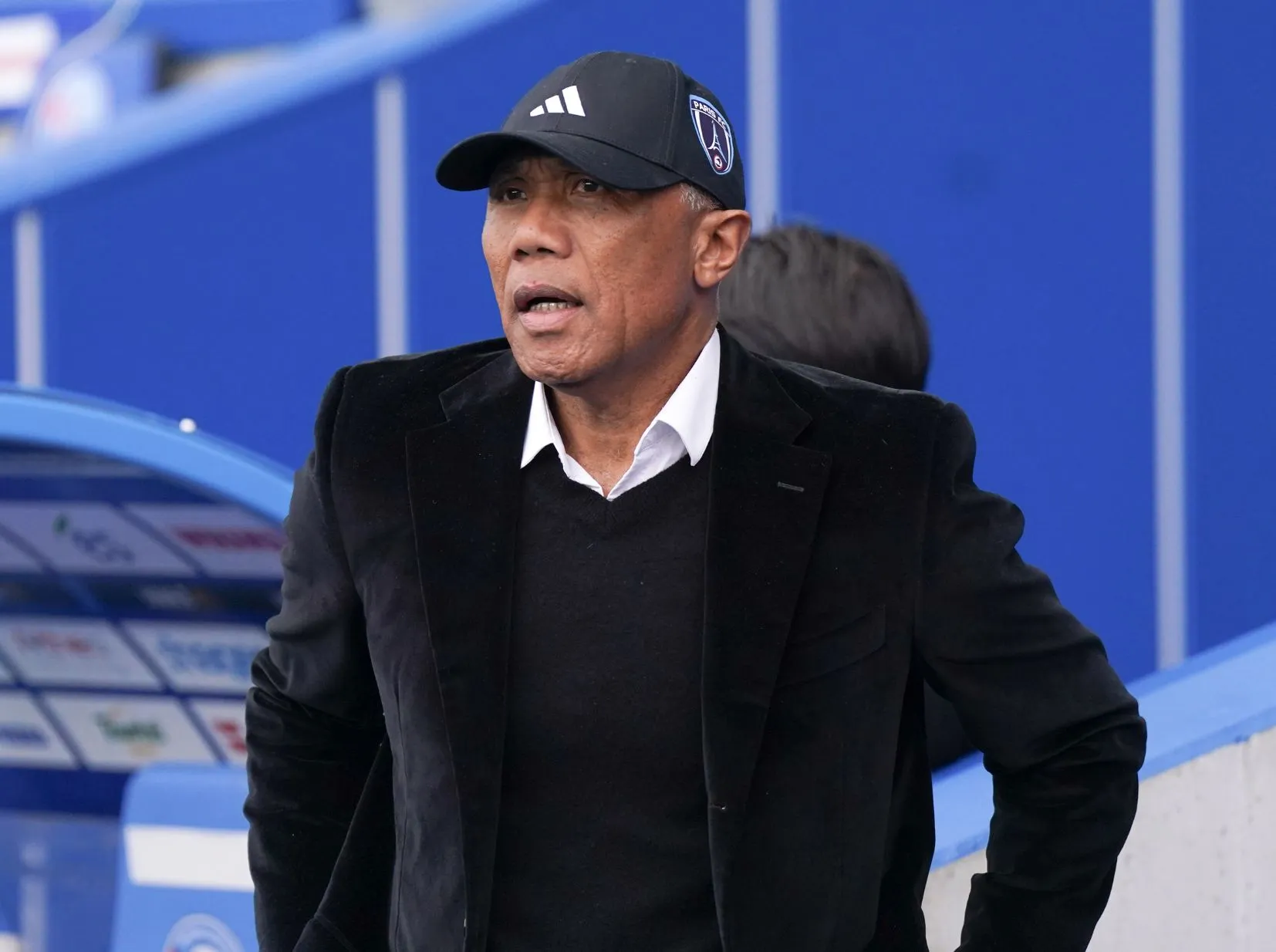
After the decisive 3-1 victory away to FC Metz, the coach struggled to hide his emotions. “I’m a fulfilled coach today. Huge congratulations to the players.”
Kombouaré repeatedly insisted that the achievement belonged collectively to the squad, yet his management quickly became one of the defining stories of Paris FC’s season.
Players spoke openly about his intensity during training sessions and his refusal to allow standards to slip once survival was within reach.
Ahead of the final match against Paris Saint-Germain, Pierre Lees-Melou revealed exactly how demanding the coach remained.
“The coach warned us all week. He didn’t want us already on holiday. He pushed us hard in training because he wanted us to finish the season strongly.”
Recruitment That Altered the Season
The revival was not built solely on emotion. Paris FC’s recruitment strategy — particularly during the winter window — played a major role in stabilising the squad.
Sporting director Marco Neppe targeted profiles capable of immediately raising the physical and technical level of the team. Several additions adapted rapidly to Ligue 1 intensity and transformed the balance of the side.
Among the standout performers was Diego Coppola, whose emergence at the heart of defence brought calmness and authority during the final months of the campaign. His performances quickly attracted attention and made him one of the revelations of Paris FC’s spring.
Meanwhile, Luca Koleosho injected explosiveness and unpredictability into the attack. Direct, fearless, and technically sharp, the winger became increasingly influential as the season progressed.
The experience of Ciro Immobile also proved valuable. Although no longer the devastating striker of his peak years, Immobile brought leadership and professionalism to a dressing room navigating enormous pressure. Reports towards the end of the season suggested the Italian forward was increasingly likely to remain at the club beyond the summer.
And then there was Ilan Kebbal. Creative, emotional, and deeply connected to the identity of the squad, Kebbal remained one of the faces of Paris FC’s Ligue 1 adventure. Concerns had initially emerged regarding his reaction to Gilli’s departure due to their close relationship, yet he remained central to the team’s survival push. Internally, the club now views him as essential to the next phase of the project.
Building Beyond Survival
What makes Paris FC especially intriguing is that survival appears to be only the beginning.
Unlike many promoted sides forced into reactive decision-making, the club already possesses a clearly structured long-term strategy.
Infrastructure investment continues at the training ground, where three new pitches are expected to open later this year. Financially, Paris FC are preparing another ambitious summer, with reports suggesting a transfer budget between €35m and €50m depending on market opportunities.
The squad itself will undergo significant reshaping.
Several players are expected to depart as the club streamlines an oversized group, yet the priority remains retaining core figures such as Kebbal and Moustapha Mbow.
Additional reinforcements are already being targeted, including another centre-forward and defensive additions.
Crucially, the atmosphere around the club now feels entirely different compared to February.
Kombouaré’s influence extends far beyond results. His management style — demanding yet deeply human — has resonated internally at every level of the organisation.
One figure inside the club described him simply as “He’s genuinely a wonderful person.”
It is difficult to imagine a stronger endorsement.
READ MORE:
>>Ligue 2: Five Players Who Could Make the Leap to Ligue 1 in 2026
>>Paris FC stun champions PSG with dramatic late derby comeback